
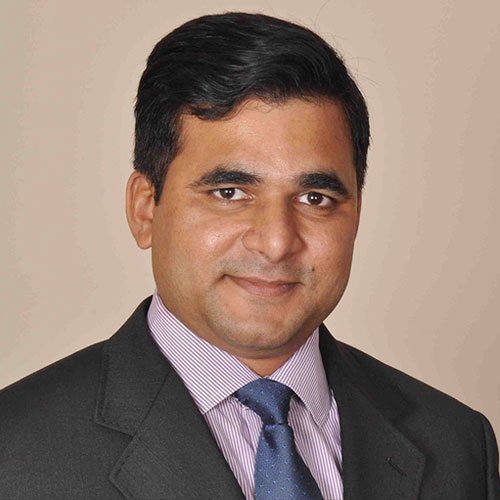
Mr. Amit Tripathi has more than 14 years experience in
financial services.
At the age of 28, he became one of the youngest debt fund managers at Reliance Capital Asset Management Ltd.
He has been with Reliance Mutual Fund for around 9 years; during this period, he has evolved into a stellar portfolio manager, combining great experience in duration management, with unique and robust credit evaluation skills. He has been an integral part of Reliance Mutual Fund's journey to become one of the largest and most respected fund houses in the country. He has been one of the main pillars of the company's successful fixed income team and has played a key role in navigating the funds through tough and volatile times. He has successfully managed various fixed income and hybrid funds which have been recognized for superior performance both nationally and internationally. As a key member of the debt investment team, he has been interacting closely within the team and with other functions such as compliance, risk, sales and product. He has also engaged extensively with key clients, distributors and the regulators through this period. His elevation to the role of Head - Fixed Income at Reliance Mutual Fund is a natural progression in his successful career.
Inflation has fallen substantially in last couple of months. What do you expect average inflation for FY14-15?
Inflation has depicted declining trends since the start of 2014 and the trend is expected to continue in coming months. RBI has targeted CPI Inflation trajectory at 8% by January 2015 & 6% by January 2016. For year ending March 2015, we believe the average CPI inflation will be 6.75% to 7%. That's because the first half average has been on the higher side at 7.75%.
The headline CPI number will trend further down in the next financial year i.e. FY 2015-16, and will easily settle below the RBI's targets.
Over the medium term, headline CPI inflation will settle below 6% for the following reasons:
Rural wages growth has been slowing. MSP price increase has been among the lowest as fiscal space is limited.
Recent cooling in global oil and commodity prices will help in reducing the imported inflation.
A stable INR ensures that these gains are adequately transmitted in the domestic context.
Rental prices are expected to moderate and stable housing prices might keep housing inflation in check.
Services inflation like transportation is likely to moderate on easing global crude prices.
A proactive government will address supply side issues.
What do expect on interest rate front? When do you feel rate cut will be started? What is your expectation on upcoming RBI review meeting?
In September 2014 policy meeting, RBI left the key policy rates unchanged in line with consensus expectations. The tone of the policy was neutral (unlike the clear dovish tone in the June policy ) with major focus on inflation. RBI remains committed to the disinflationary path of taking CPI inflation to 6% by January 2016. While inflation trajectory will fall below 8% in early 2015, it is critical that the disinflationary process is sustained over the medium-term.
We expect RBI to keep policy rates on hold till the December policy given RBI’s current policy guidance and vigil on inflation trajectory. But the rate cutting cycle would be gradual keeping in mind the upside risks to RBIs target of 6% CPI Inflation by Jan 2016. We believe that key will be to watch the trajectory of actual inflation vs. RBI’s forecast. Last few data points and underlying drivers (fiscal deficit, rural wage growth, MSPs) indicate that there is a possibility that actual inflation outcome surprises positively and decelerates faster than RBI’s expected trajectory and our expectations.
According to you, what investors should look before investing in Accrual funds?
Accrual funds are those funds wherein the main source of returns comes from interest income (accumulation of interest received from the underlying securities in the portfolio) rather than capital gains (i.e from mark to market), over the holding period horizon.
There will always be a trade off in high returns vs high risk. In accrual funds, this risk is essentially credit risk. Hence from a investor stand point, its not advisable to just look at portfolio gross yields but more importantly to look at the fund house track record in managing these funds, and the quality of the credit research team and process that supports these funds. Off late we have seen a lot of credit / accrual funds being launched, which should be carefully considered for the above comforts, before any investment is made.
From RMF perspective, Reliance Regular Savings Fund- Debt option is a time tested offering (since 2006) within this space, which seeks to generate accrual returns through yield enhancing credit exposures both in plain vanilla as well as structured assets. All exposures are backed by thorough research and structuring expertise. Right structuring further mitigates credit risk without impacting yields.
Adequate resourcing for this fund activity is ensured in form of a senior portfolio management team supported by a highly experienced four member credit team, which in turn is guided by the AMC level Investment Committee and an independant risk management function.
Please give some insight on your investment process.
On the fixed income side, we manage nearly Rs.87,000 Crs of assets across various liquid and debt schemes. We have one of the most experienced Fund Management Team of 6 members with cumulative experience of 75 years and expertise in managing funds across credit and duration strategies and delivering returns across cycles.
Our investment process revolves around 3 main parameters:
Key inputs to investment decisions (Macro Economic Analysis, Credit Analysis, Liquidty Analysis)
Portfolio construction - Based on scheme objective and views regarding interest rates, credit and pricing environment and liquidity, portfolio is constructed. However the Fund Management Team manages the portfolio within the investment ranges stipulated for various parameters like Asset allocation, portfolio duration, credit profile, portfolio liquidity.
Portfolio Monitoring is done on the parameters like macro analysis & updates, market positioning, risk pricing, demand supply dynamics, optimizing asset allocation, operational & financial analysis of the company
We have one of the largest credit research team of 4 credit analysts and one person in credit support, with cumulative experience of more than 35 years. This is a separate team within the Fund Management department that helps fund managers to research proposed investments and monitors the credit standing of issuers. That apart, Risk Management also does an independent analysis and reporting on various performance attributes. We use robust risk management systems, advanced information technology, proprietary models for portfolio analysis to aid and enhance the investment process.
With a one year perspective, which category of funds looks more attractive?
In view of the current market scenario, wherein short to medium end of the yield curve also looks attractive and with credit environment improving, opportunity to invest in high yielding private credit structures exists, investors with a one - two year holding period perspective, can consider investing in two of our Conservative Debt Offerings (Reliance Short Term Fund & Reliance Regular Savings Fund - Debt Option)
The main source of potential returns for Reliance Short Term Fund is through a mix of accrual and capital gains, while Reliance Regular Savings Fund- Debt option is an accrual focused fund. As a corollary, Reliance Short Term Fund majorly invests in highly rated and Sovereign Bonds, while Reliance Regular Savings Fund- Debt option mainly takes exposure in well researched private credit assets.
However, with our positive view on structural shifts in the underlying macro fundamentals which can result in a meaningful shift downwards in yields over the medium term, we believe it is crucial for investors to build duration in their portfolios with a slightly longer holding period of 18 - 36 months. In such a scenario, investors may select funds that focus on efficient duration management to generate alpha. Our one such offering, Reliance Dynamic Bond Fund is well positioned to maximize returns from the potential drop in yields.
